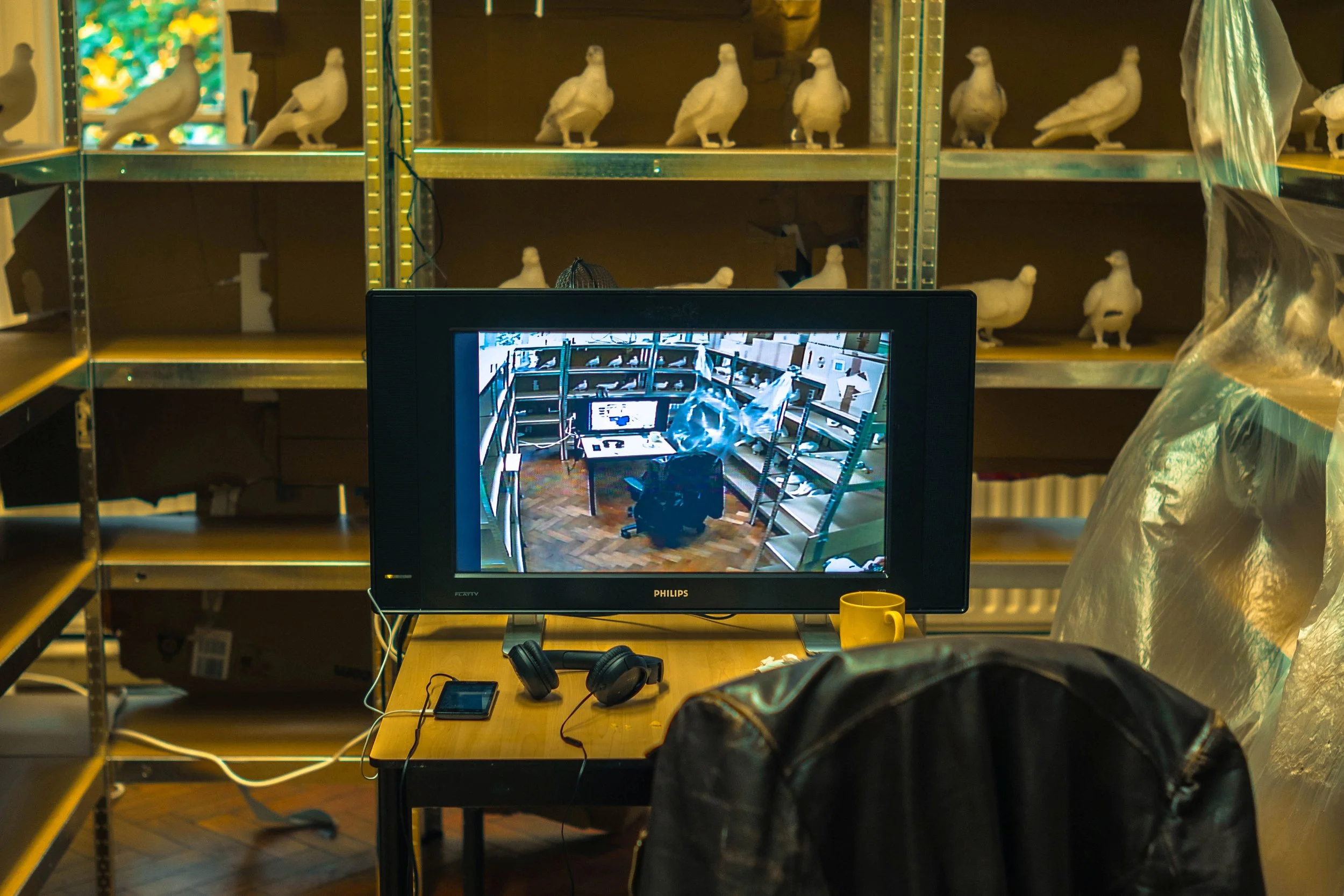
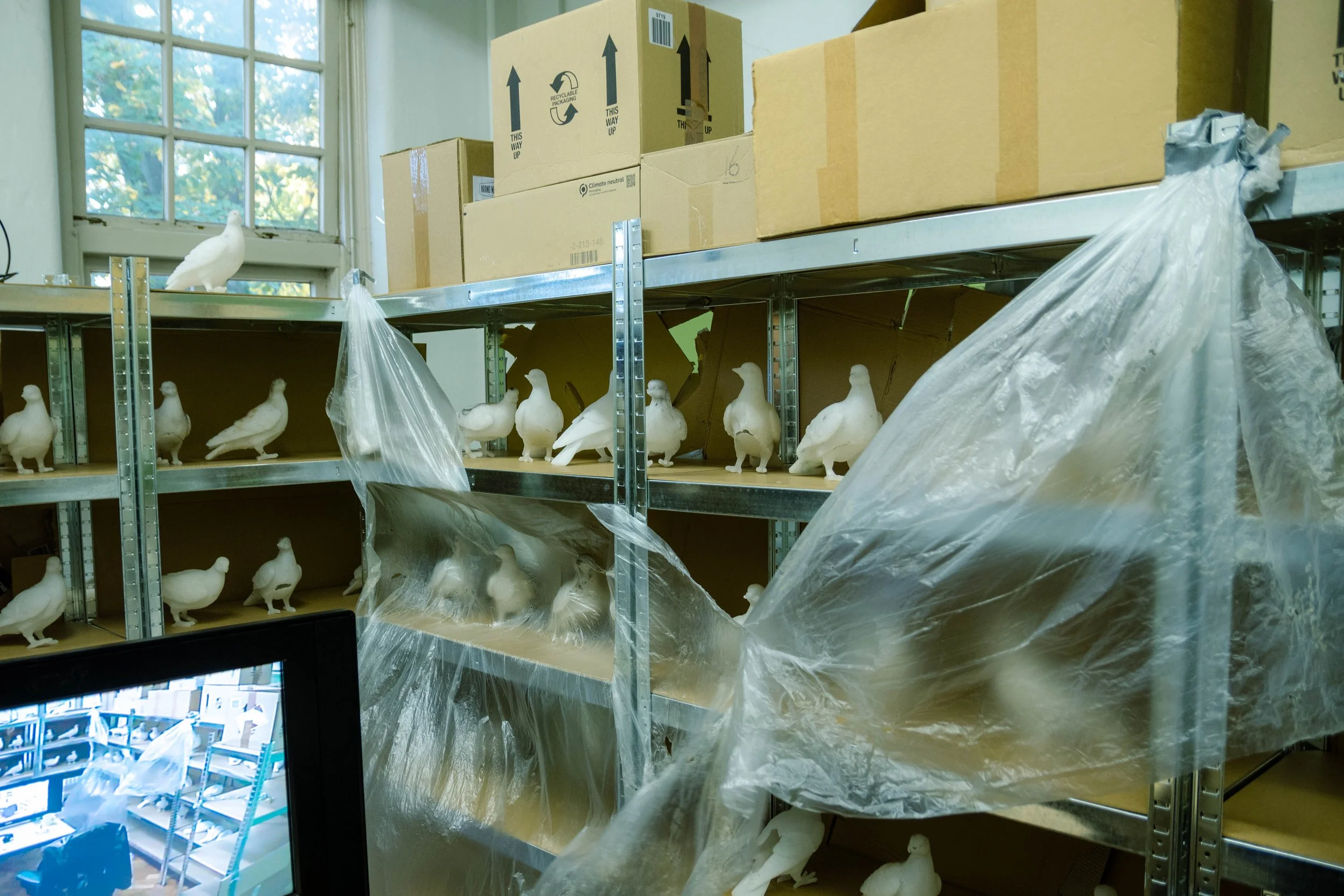
Visitors are invited to step into a fictional archive. It could be set in our (im-)possible past, present, or future. Here, nothing escapes the scrutinising eyes of the archivist and his surveillance camera.
The archivist has just left.
Has he joined the revolution?
Has he gone to pee?
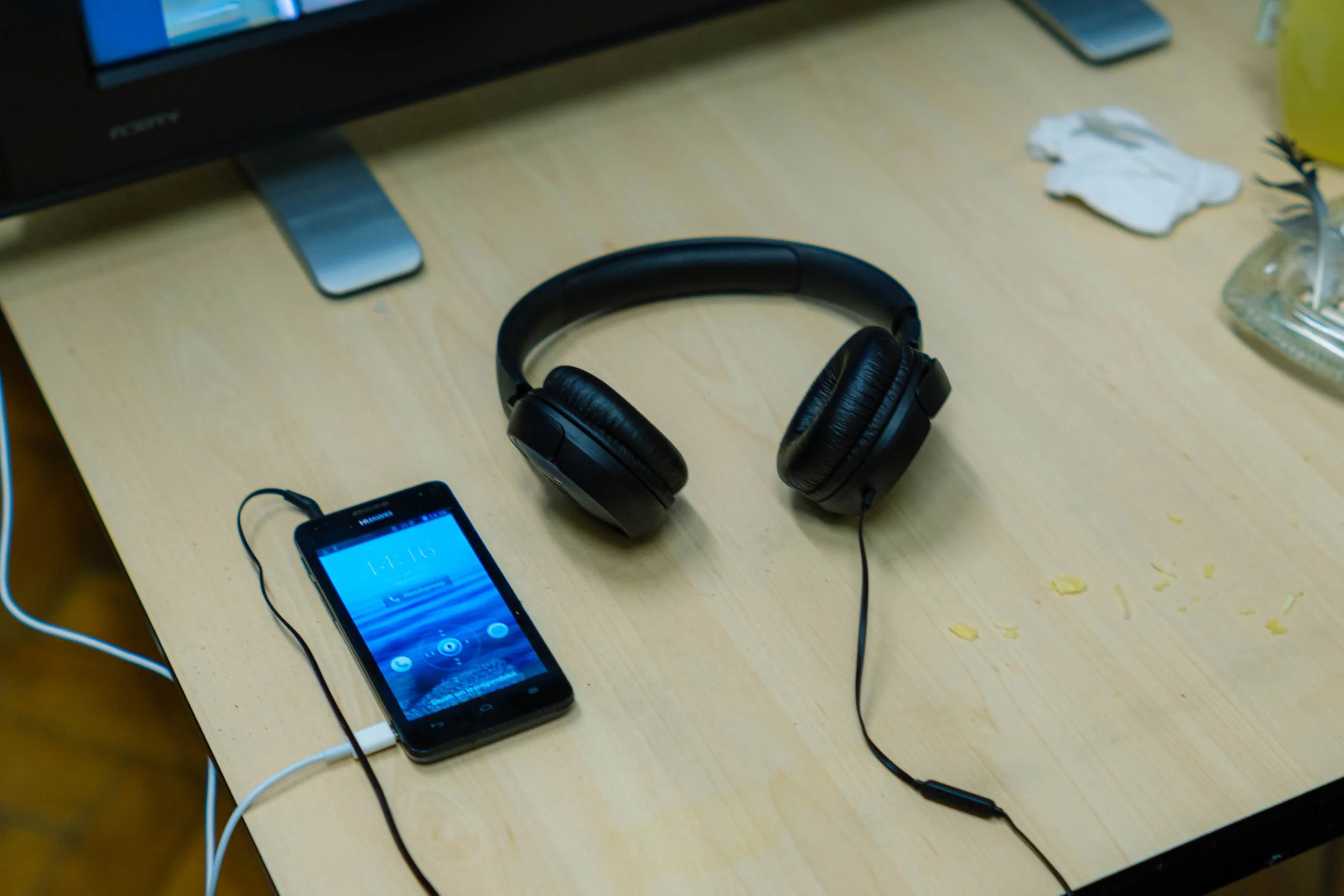
The archivist has left his headphones behind. Put them on to breathe in relaxation and breathe out the weight of systemic oppression.
The Archive is a fictional space. It is a system of preservation and surveillance that appears to serve no higher purpose other than upholding itself. The Archive raises questions about authority, care, and control within the structures of knowledge preservation and observation of land, people, and non-human animals.
Sound Design by Valen Vogl
Images curtesy of Nikita Dyatlov
The Archive is exhibited as part of the group exhibition
Tender Territories
at
Areal Böhler
Read more at
The Archive was developed during my time with Borderland Residencies as a resident at Museum Het Nieuwe Domein (NL).
Read a snippet of my ongoing research:
The Great Misunderstanding is the umbrella under which I conduct my research on the question:
How do we share urban space in relation to each other, other species, and our inanimate environment?
In The Archive, I research this question through the lens of the pigeon.
Pigeons are our oldest companion species. Since we first domesticated them more than 10.000 years ago pigeons have been considered symbols of peace, war heroes, hunted pests, and sacred messengers. Once our technological advancements substituted the pigeon´s service, we discarded them. Now the pigeon roams our streets alongside us, living in and off our dirt – depending on our infrastructures. The pigeon´s ambiguity reflects the seemingly contradicting ways in which we share spaces - with each other and other species.
My research is informed by Ursula Le Guin’s The Carrier Bag Theory of Fiction and by an interest in non-heroic, non-linear narratives within the history of science and technology studies.
During my residency at Museum Het Nieuwe Domein I focussed on the local mining history in Sittard-Geleen, with particular attention to the violent narrative of societal advancement through extraction and expansion: the domestication and domination of a people, land, and non-human animals.
Within this context, I am developing a constellation of multiperspective, non-linear scenes. These take the form of multimedia installations that invite audiences to reflect on habitual ways of sharing (urban) space with one another and with non-human animals. Functioning as interactive set designs, the installations encourage physical and emotional engagement with the ambiguities and contradictions of interspecies cohabitation.